19 May 2026
Why Most Founder's Office JDs Say "Apply Only If You're Building in 2 Years"
Why do founder's office JDs screen for future founders? A breakdown of the "2-year" line — what founders believe, what critics say, and what it's actually doing.
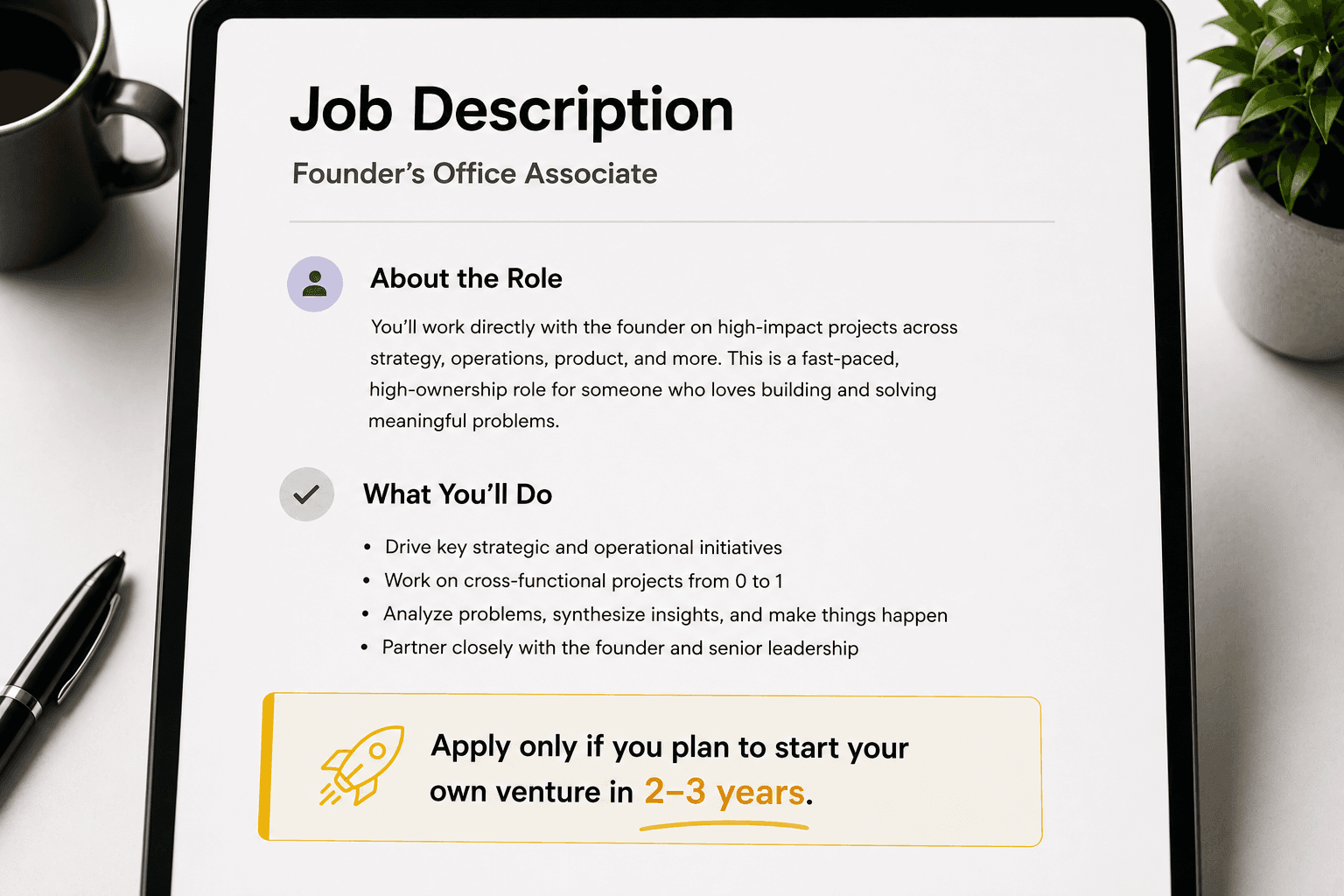
I've gone through dozens of founder's office job descriptions over the past few months.
Different companies. Different stages. Different founders. But one line keeps showing up almost word for word:
"Apply only if you see yourself starting a business within the next 2 years."
The first time I saw it, I thought it was strange. Why would a company actively screen for people who are planning to leave?
The more JDs I read, the more I realised — this line isn't accidental. It's deliberate. And depending on who you ask, it means very different things.
What I kept noticing
It wasn't just one or two outliers. This line showed up consistently across founder's office, chief of staff, and founding team roles, almost always at early to mid-stage startups where the founder is still deeply involved in day-to-day decisions.
It never appeared in traditional ops roles. Never in finance or marketing JDs. Only in the roles that sit closest to the founder.
That pattern alone tells you something: this isn't a generic culture line. It's specific to a specific type of hire.
The case for it — what founders who use it believe
Talk to founders who write this line and their reasoning is consistent. They're not hiring for a job. They're hiring for an energy. And the clearest proxy they've found for that energy is someone who is building toward something of their own.
Amit Somani, Managing Partner at Prime Venture Partners, captured it well: startups should actively seek out people who say they want to start their own company in 2 years because these people think like owners, spot problems, and want to solve them. Not despite their ambition, but because of it.
For founders who think this way, the 2year line is a forcing function,it attracts people with ownership mindset, filters out people looking for comfort, and signals what kind of company they're trying to build.
The case against it what critics say
Not everyone agrees. And the pushback is worth taking seriously.
Some argue it's an unfair filter that screens out excellent operators who simply don't have founding ambitions. Why lose them?
Others point out that it can become a self-serving narrative. Founders get high-output work from ambitious people, then frame the eventual departure as a feature rather than a cost. The person still leaves. The institutional knowledge still walks out.
There's also a diversity angle. The future founder identity skews heavily toward people who already have safety nets savings, family support, the confidence that comes from privilege.
What it's actually doing, either way
Whether you agree with the line or not, it does one thing reliably: it self-selects for a mindset.
Someone who reads "apply only if you're building in 2 years" and thinks yes, that's me already understands the role. They know it's a sprint with a ceiling. They'll treat it like a masterclass, not a job.
The line works as a filter precisely because it's polarising.
The question worth sitting with
If you're a founder writing a JD, is this the filter you actually want? Or is it shorthand for something you haven't fully defined yet?
And if you're a candidate reading it does it excite you or put you off? Your answer tells you more about fit than any interview question will.
The people who can actually answer this
The real answer sits with one specific group — those who joined a founder's office with that 2-year intention, did the role, and then actually went on to start their own company.
Did the role prepare them the way founders claimed it would? Did it accelerate their path or just delay it?
If that's you — I'd genuinely love to hear from you. Reach out. This article should be the start of that conversation, not the end of it.
Founder's office roles sit at the intersection of strategy, execution, and trust. This site is dedicated to understanding exactly what that means through the people who've lived it.
Reach me at klharshitha1@gmail.com always up for a conversation.
Currently building my path to a Founder's Office role and documenting everything here.